

Primary Research (Digital Survey)
The Digital Survey was distributed online and capped at 60 respondents. The purpose is to gauge Singaporeans' understanding of scoliosis and their views of those who have scoliosis.
4/5 of the respondents did not answer all the true-false questions in the survey right. This corresponds with the gap in my project, where the majority of society has misconceptions about scoliosis.


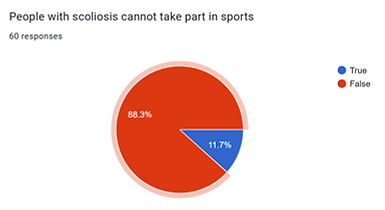


Data from these two questions, used as evidence, is extracted from individual responses.

Respondents who knew someone diagnosed with scoliosis think it affected them more physically than mentally. Almost all respondents (with the exception of one) who voted that scoliosis negatively affected patients mentally also voted that it negatively affected patients physically. This shows that it might be hard for them to ascertain how scoliosis affects the diagnosed as my other primary research and secondary research suggests that scoliosis affects patients more than it seems.
_edited.png)
Word cloud of the most common words respondents used to describe how they felt when looking at a person wearing a brace
A lot of respondents remain neutral. However, some respondents who think that there is no stigma against people with scoliosis contradict themselves with their views of bracing treatment. They state words like "weird, disabled, and unpleasant". One respondent said bracing made the wearer look like they were trying to lose fat. The fact that there are such comments in my survey shows that there is implicit stigma and my respondents are incorrect in thinking there is no stigma against people with scoliosis.
Primary Research (Interview)
Video call interview of Singaporeans who have passed the progression stage of scoliosis. Interviewees were chosen from friends of friends, rather than random sampling, as I believe the mutual connection allows for a more comfortable and trustworthy environment.
Legend: Interesting points
Inferences
Cross-reference of data and information from both digital survey and interview:
-
A common symptom among interviewees is body asymmetry
-
Some symptoms differ and has no correlation to how severe the curve is (interviewee 1's curve was severe, and some might assume that it would cause back pain, but he said that he did not feel any pain)
-
Symptoms that differ: back pain, back soreness, shortness of breath, cannot sit still for a long period of time
-
Some interviewees experience trouble exercising due to pain or uncomfortable positions (bending)
-
Stretching helps with back pain, but missing a day will make the pain worse
-
Interviewee 1 delayed seeking treatment as they didn't want to stand out, interviewee 2 didn't want to commit to treatment, and Interviewee 4 delayed seeking treatment by postponing appointments, as they didn't want to face the reality that their efforts with brace-wearing would be in vain
-
Bracing helped to curb the progression of the curve, but interviewees who went through bracing felt that it was a hassle, uncomfortable, and didn't want to stand out
-
Surgery straightened the spine, but there is still a small curve
-
Scoliosis negatively affected some interviewees' self-image physically - body asymmetry, body image, and height (became shorter).
-
Scoliosis negatively affected some interviewees' mentally - helpless, demoralizing (thinking they had to deal with this forever), not good enough, looking abnormal
-
Respondents from the digital survey may not have gone up to those with scoliosis to better understand how scoliosis affects them physically and mentally as scoliosis' manifestation is not very visible
-
-
Interviewee 2 said that the pain affected their daily life, but it was not severe enough to do something about it
-
Wearing a brace made interviewees feel different, both in a good way and a bad way. Some friends think it's cool, and some pick on the patient, which affects their will to brace
-
The experiences of interviewees suggest that the responses from the digital survey might be a result of conformity bias as email is required for the digital survey. From the word cloud, we can see that most adjectives used to describe brace-wear are neutral.
-
-
Interviewee 2 said that their family was worried that they didn't want to commit to bracing. They got annoyed as it was physically and mentally draining to put the brace on
-
Interviewee 3 said that their mom was very affected as she was a health-conscious person, she searched up how scoliosis affects health and birth-giving. She also hated how it made Interviewee 3 look. She got mad when they did not want to exercise and blamed them for causing scoliosis (misconceptions such as not having good posture, and carrying heavy bags.) They got annoyed as it was not something they could control and about the misconceptions
-
Interviewee 4 said that their parents freaked out and took it badly. They did not want to see their parents in that state as it was not something they could control
-
Interviewee 4 contradicted themselves. They said that they don't care or mind being diagnosed with scoliosis now, but will care if it gets worse. They might be worried about having the condition and may be masking their true feelings due to the Hawthorne effect. They want to enhance the perception of their positive outlook and appear stronger.
-
With the exception of one interviewee, the rest agreed on a scale of 1 to 10 (10 being extremely common), around 7 that it is common for Singaporeans to have misconceptions about scoliosis. This corresponds with the results from my digital survey, which showed that 4/5 respondents had misconceptions
-
Incorrect comments received: think scoliosis is kyphosis (humpback), scoliosis originates from bad posture, scoliosis makes patients lean to one side
-
Interviewees think that there are incorrect comments because society does not know much about scoliosis, they will not search for it unless they have it, not many people talk about it, school checkups did not explain what the checkup was for
-
What interviewees think can be done to reduce the spread of incorrect information: Fact check with patients (don't assume), better communication from doctors (no fearmongering), teach students during checkups or integrate into health programs, have information sessions
-
Responses from the interview might not be sincere as there is no former connection
-
Challenges faced: inability to sit still for long hours, back pain, fear of their curve worsening in the future, mental distress
-
Girls are more self-conscious about self-image, being young and sensitive
-
Do what they can while they still can to manage scoliosis
-
Management control is better than surgery
-
Fabric braces exist, but they are more for correcting posture